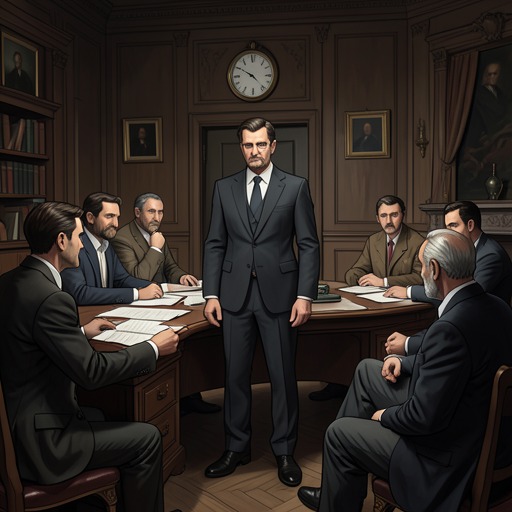
Devereaux’s decision to leave the university
Straight ManWilliam Henry Devereaux, Jr.’s decision to leave the university is both a refusal of advancement and an attempted break with academic life. He turns down the deanship and plans to relinquish his tenure, yet his resignation never takes effect; instead, he returns to teaching under a temporary arrangement. The episode’s central tension is between departure as a decisive gesture and the ongoing ties that pull him back into university work.
The Decision and Its Symbolic Meaning
William Henry Devereaux, Jr. describes turning down the dean’s position and relinquishing tenure as the symbolic equivalent of passing a kidney stone. The comparison links a career decision to his recent urinary crisis, but he distinguishes the metaphorical release from a physical event. Phil Watson insists that symbol and matter remain separate, even as William Henry Devereaux, Jr. sees the coincidence of his decision and recovery as meaningful. The episode thus gives the choice emotional weight without presenting it as a literal cure or a complete resolution of his physical symptoms.
The decision marks a change in what William Henry Devereaux, Jr. is willing to take on: rather than accept the dean’s office, he intends to leave the university. But the account complicates any simple reading of the choice as final. His stated intention to sever ties becomes only one part of a longer, less controlled transition.
The Resignation That Does Not Take Effect
William Henry Devereaux, Jr. tenders his resignation to Jacob Rose, but the letter is somehow lost. He then discovers that he is owed a half-year sabbatical, a benefit he had forgotten when he agreed to serve as temporary chair. As a result, he is scheduled to teach in the fall and take leave in the spring, rather than depart the university outright.
The change is not described as a deliberate reversal of his decision: the missing letter and the overlooked sabbatical alter what happens to his plans. His departure therefore remains incomplete. He has refused the deanship and tried to resign, yet the institution continues to claim part of his working life and leaves open a return to teaching.
Continuing Academic Ties
The arrangement brings William Henry Devereaux, Jr. back into contact with students. He has more advisees than anyone else in the department, and his fall list is to include Blair and Bobo, who come together to declare themselves English majors. Bobo, whose name is John, has a García Márquez novel with a page turned down; William Henry Devereaux, Jr. tries to explain that being an English major is not a military designation, but Bobo remains undeterred. Later, he sees Bobo holding Blair’s hand and stroking her wrist. The advising relationship places the would-be departing professor back among students at the very moment his resignation appears to have failed.
Leo is not among his advisees, but sends him a letter several weeks after the term ends, along with the first hundred pages of a novel. After moving to a cabin in the mountains, Leo has written about a young novelist who leaves the university after a disastrous semester, convinced that no one, including his writing teacher, understands his revolutionary work. The manuscript echoes the possibility of departure through a student’s fiction, while William Henry Devereaux, Jr. remains connected to the university as the reader and recipient of Leo’s work.
A Possible New Arrangement
Jacob Rose retrieves a grant proposal that Lily and William Henry Devereaux, Jr. wrote nearly a decade earlier and submits it to the chancellor without their permission. The proposal would follow academically promising, disadvantaged high-school students around Railton from their sophomore year and guarantee tuition and books at the university’s Railton campus as long as they maintained their grades. With Lily promoted to principal at the high school, the proposal now appears more practical to its advocates.
The proposed pilot would involve William Henry Devereaux, Jr. teaching part-time at the campus and part-time at the high school, with the number of classes still to be negotiated. Paul Rourke learns of the plan and calls it a typical Devereaux boondoggle, though he does not seem interested in opposing it. The proposal is not presented as an accomplished program, but it sketches a future in which William Henry Devereaux, Jr.’s work could continue across both institutions. His decision to leave thus ends not in a clean break, but in a provisional arrangement shaped by teaching, advising, and a project he had helped devise with Lily.